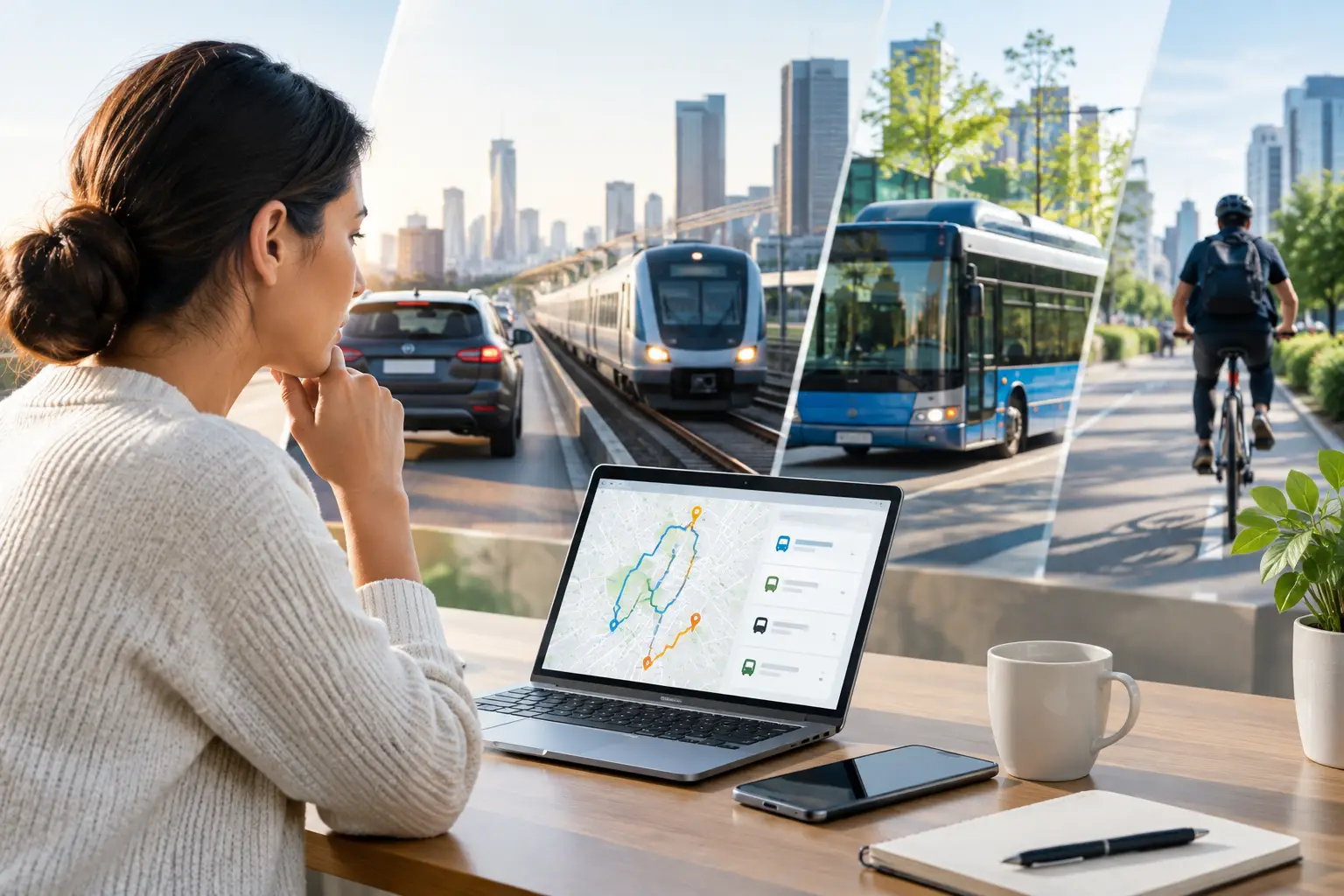
A home that looks perfect at 11:00 a.m. on a Saturday can feel very different after a 6:20 a.m. departure, a crowded platform, and a late-evening drive back from the station. For buyers considering Bergen County and nearby Northern New Jersey communities, learning how to compare commute times is not just about finding the fastest route. It is about understanding how a location will shape the pace, cost, and flexibility of everyday life.
A stated commute time can be misleading because it often measures only the trip itself. The real question is how long it takes to get from your front door to your workplace, school drop-off, or final destination in Manhattan, Newark, Jersey City, or another employment center. A few minutes on a map can become 30 minutes once parking, transfers, traffic, and walking are included.
Start With the Real Door-to-Door Commute
The most useful comparison begins at your actual departure point, not at the town center or nearest highway entrance. If you are considering a specific house, map the trip from that address at the time you would normally leave. Then map the return trip during the hours you are likely to travel home.
For a rail commute, include the drive or walk to the station, time spent finding parking, waiting on the platform, train travel, any transfer, and the walk from the terminal to your office. A property that is technically close to a station may still require a drive if the route lacks sidewalks, crosses a busy road, or is difficult in winter weather.
For drivers, compare more than mileage. Northern New Jersey traffic can change sharply based on the route, weather, construction, school calendars, and the time you leave. A 14-mile trip to a job in Paramus, Hackensack, or Manhattan can have a very different experience depending on whether it relies on local roads, Route 17, Route 4, the Garden State Parkway, the New Jersey Turnpike, or a bridge or tunnel crossing.
Run each route at least a few different times. Morning peak, evening peak, and a mid-day test will give you a more realistic range than a single estimate. Planning around the best-case result can create frustration quickly after move-in.
How to Compare Commute Times by Town
When comparing towns, look at transportation patterns rather than assuming one community is universally better for commuters. Bergen County is highly connected, but each town offers a different set of trade-offs.
Communities with direct rail service may appeal to commuters headed to Hoboken or New York City, while other locations are better positioned for express bus service or highway access. Towns near major corridors can reduce driving time for one job location but may bring more local congestion, road noise, or a less walkable feel. A quieter residential neighborhood farther from transportation may offer more space or a different lifestyle, but it can add meaningful time to the daily routine.
It also matters where within the town you live. In larger communities such as Ridgewood, Teaneck, Paramus, Mahwah, or Fort Lee, one neighborhood can have a substantially different route to a station, bus stop, highway, or school than another. Buyers should avoid treating municipal boundaries as the whole story.
A practical way to compare options is to create the same door-to-door calculation for every property you are seriously considering. Write down your morning departure time, arrival time, return trip range, monthly transportation cost, and the number of transfers or driving segments involved. This makes it easier to see whether a lower home price or larger yard comes with a commute you will be comfortable repeating five days a week.
Compare Reliability, Not Just Speed
The shortest route is not always the best route. A slightly longer train trip with fewer transfers may be more predictable than a faster-looking route that depends on tight connections. Likewise, a drive that looks efficient on a typical day may be vulnerable to a single bottleneck near a highway entrance, school zone, bridge, or tunnel.
Consider how the commute performs when something goes wrong. If a train is delayed, is there an alternate line, bus route, or practical driving option? If traffic backs up, can you take a secondary road without adding an hour? Families with child-care pickup deadlines often value predictability more than a route that is theoretically faster on a good day.
Remote and hybrid work have changed this calculation, but they have not eliminated it. If you commute two days a week, you may accept a longer trip in exchange for a larger home, more outdoor space, or a preferred school district. If you commute four or five days a week, a difference of 20 minutes each way can amount to more than three hours every week.
Account for Parking, Fares, Tolls, and Daily Friction
Transportation costs should be part of your home budget, especially in the New York metro area. Train fares, parking permits, garage fees, tolls, fuel, vehicle wear, and occasional rideshares can add up quickly. A home with a lower purchase price may not be the more economical option if the monthly commute cost is significantly higher.
Parking deserves special attention. Some stations have permit systems, waiting lists, limited daily spaces, or private lots. Availability can vary by municipality, residency status, and time of arrival. Before making an offer based on a train commute, verify how station parking works for that specific town and whether walking, biking, or being dropped off is a realistic alternative.
The same principle applies to bus commuting. Find out where the stop is, how often service runs during your travel window, whether seats are typically available, and what the walk home feels like after dark. A route that works well for one household may not work for another with young children, late office hours, or a schedule that changes often.
Test the Commute in Person When You Can
Digital maps are an excellent starting point, but they cannot show you the full experience. If a commute will strongly influence your decision, test it before your inspection period ends or before you remove a town from consideration.
Drive the route at your normal departure time. Take the train from the actual station. Walk the route from the terminal to the office or workplace. Notice whether you feel rushed, whether the parking process is manageable, and whether you would be comfortable making the return trip in bad weather or after a long day.
If you are relocating from outside the area, ask a local real estate advisor for context on the transportation options surrounding the homes you are considering. The Falco Group helps buyers look beyond a listing's distance-to-station description and evaluate how a particular location fits their work schedule, school plans, and preferred lifestyle.
Consider the Household, Not Only One Commuter
A commute decision affects more than the person traveling to work. One spouse may commute by rail while the other drives locally. Teen drivers may need access to a vehicle. A caregiver may need to reach school, sports, medical appointments, and errands without being limited by a commuter car or complicated traffic pattern.
Think through the weekly calendar. Can you make it to an early practice after a city workday? Does a late train arrival make dinner, homework, or child care harder? Would a nearby station create convenience, or would the added activity and parking demand change the feel of the street you choose?
There is no universal right commute for Northern New Jersey buyers. Some households prioritize a direct rail line and a walkable downtown. Others prefer highway access, more space, or proximity to family and schools. The right choice is the one that supports the life you expect to live after closing, not just the route that looks best on a screen.
Before you become attached to a home, give its commute the same careful attention you give its layout, taxes, and school options. A realistic test can turn a vague concern into a confident decision about where you will feel most at home.